
The 2026 Ginghamsburg Church Impact Report Magazine will be available in print and distributed at Ginghamsburg on Sunday morning, November 8. This post is the second of three that takes a closer look at how the publication came to be.
Flavor, relationship and invitation.
Ginghamsburg Church, as long as I’ve known it, has always been a place for everyone. I remember Dougie Fresh, who used to wear his Michael Jackson glove every time he sang in the choir. I remember Deb, who hid a tiny dog in her purse so she could take it to worship and feed it communion. I remember the poop on Gwen the bird lady’s shoulder. She insisted on sitting in the front row with her pet parakeet.
I’ve met skaters and musicians, painters and business owners. I’ve shared meals with former felons, played basketball with former pros, traveled with doctors and car salesmen, become friends with a rocket scientist and a truck driver, and worked with a Grammy judge.
Somehow, God has used all of our twisted, entangled stories to do some pretty incredible things. How do felons, painters, bird ladies and car salesmen come together to change the world?
The table.
Way back when I was in college, I learned about different theories of mass communication. One of them is systems theory. Systems theory helps us see how people, practices and messages connect: What happens in one part of a system can shape the whole.
Worship is one example on a large scale. We bring our lives into Sunday worship, where music, prayer, Scripture and community help us make sense of them. Then we carry that perspective back into everyday life. Repeated across a congregation, that influence can reach into society.
The family dinner table works on a smaller scale. People bring their days to the table, share stories, listen and shape one another before heading back into the world.
That’s why a table became the central iconography for the cover of the Impact Report: It represents a place where individual lives meet, influence one another and go back out into the world as shared impact.
The table is about exposure! It’s an expression of flavor through food, exposure to one another through relationship, and belonging through invitation. Pull up a chair!
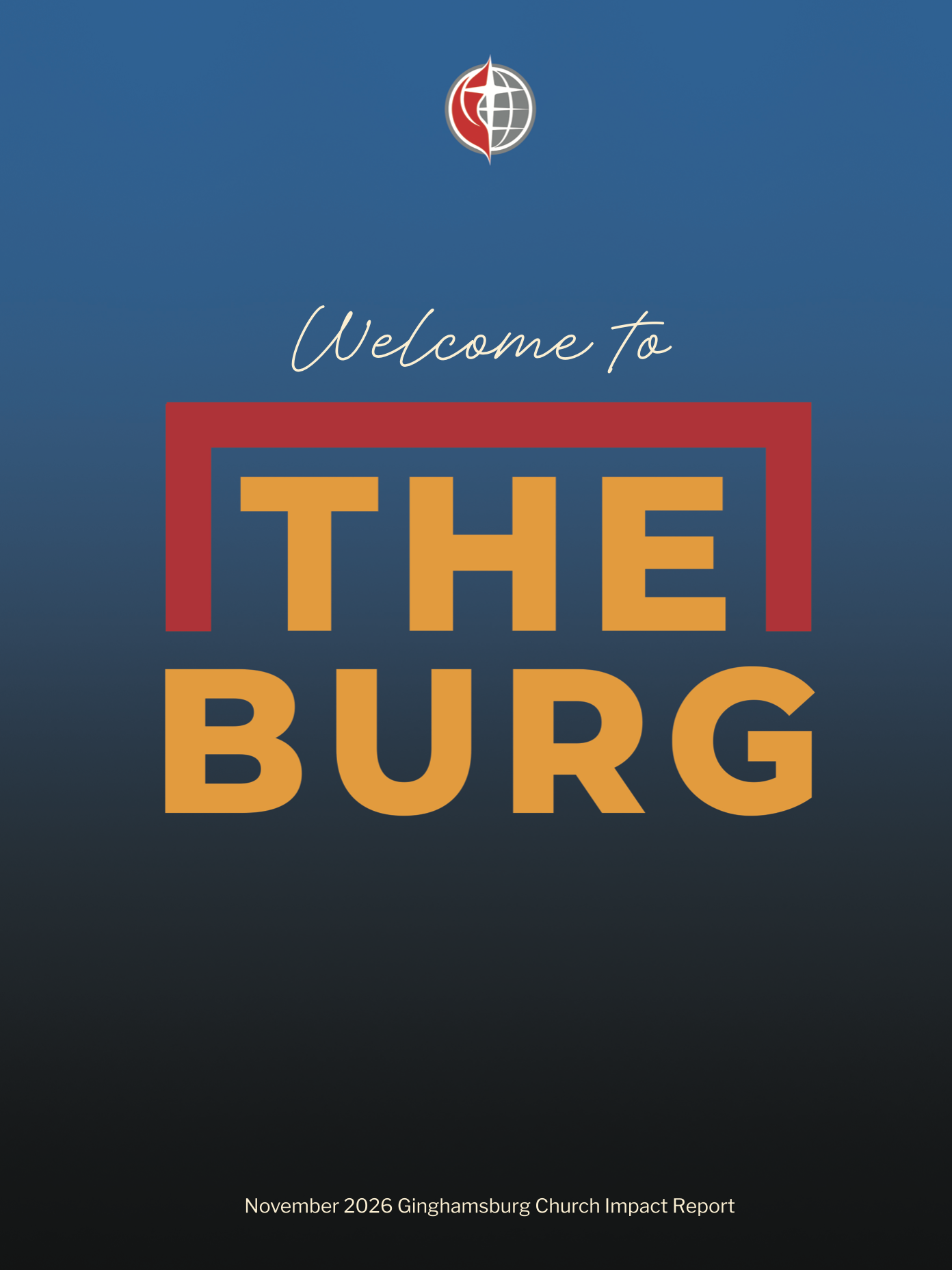
That brings me to “The Burg.”
Have you ever heard of an affectionate diminutive? It’s a nickname that makes a name feel familiar and personal — like it belongs to you. “The Burg” can work that way for Ginghamsburg.
Brands and communities use familiar nicknames all the time. See how many of these you recognize:
Mickey D’s • B-Dubs • the ’Bucks • Timmy’s • the Bell • the Barrel • Wally World • the Depot • the ’Co • Chevy • Harley • Caddy • Subie • Lambo • Nat Geo • FedEx • Bud • Dew • Coke • Jack • the Mouse
“Daniel Bracken” sounds formal and professional.
“Dan” sounds familiar but generic.
“Dannio” sounds personal, creative, unique and identifiable.
The diminutive makes it useful for freelance work, where clients are hiring based on taste, perspective and creative judgment, not merely purchasing a standardized service. “Dannio” is stronger as a signature or creative identity than as a conventional company name. It gives me more personality and recall, while “Dan Bracken” can still carry the formal credibility underneath it.
In the same way, Ginghamsburg is the formal identity, and The Burg is the relational identity. “The Burg” is not only shorter; it signals that people know the place well enough to call it something personal. Its insider quality is not a barrier; it is both personal and publicly accessible.
This “renaming” is driven by a desire to make Ginghamsburg feel less like an institution people visit and more like a community they belong to.
Why “The Burg”?
1. Lower the intimidation barrier
“Ginghamsburg Church” is formal, long and a little difficult for newcomers to spell or pronounce. “The Burg” is casual, memorable and easy to say.
That could matter for people who are curious about community but hesitant about church.
2. Create a sense of insider belonging
Nicknames imply relationship. You usually do not nickname something until it feels familiar.
“The Burg” can communicate:
- This is our place.
- These are our people.
- You do not have to be formal here.
- Pull up a chair.
It supports the table-and-belonging language we’ve already been exploring.
3. Sound more local and rooted
“Burg” evokes a town, settlement or community. That gives the nickname a useful double meaning: It’s a shortened form of Ginghamsburg and a place where people gather for shared life.
4. Give the brand more cultural flexibility
“Ginghamsburg Church” still works well for formal and institutional purposes. “The Burg” gives us a flexible secondary identity for apparel, social content, hospitality language, community partnerships and more. It becomes the conversational layer of our brand rather than replacing our historic identity.
5. Create emotional distance from institutional baggage
Some people carry skepticism about churches, denominations and organized religion. “Ginghamsburg” carries baggage distinct to our local community. That baggage may come from pastoral transitions, pandemic response, theological shifts or denominational splits. A nickname can create needed emotional distance and space for a new identity to take form.
“The Burg” may allow someone to encounter the people and the community before making a judgment about the institution.
6. Preserve history while signaling change
A complete renaming could feel like abandoning nearly 170 years of history. Keeping Ginghamsburg as the primary name while introducing “The Burg” says we are not discarding who we have been. We are becoming more conversational about who we are and more rooted in who we’ve traditionally been.
7. Make the congregation the main character
“Church” can be interpreted as a building, an organization or a Sunday service. “The Burg” can be framed as the collective community: The Burg is not the building. It is the people around the table.
That could support a broader vision of church as spiritual formation through relationships and shared life, not merely attendance.
The nickname gives our historic identity a warmer, more conversational expression — one that feels local, memorable and welcoming to people looking for purpose, connection and a place at the table.
A nickname becomes powerful when people naturally begin saying it. The congregation ultimately decides whether it becomes real.
In my next post, we’ll talk about the guts of the Impact Report: its content, its layout, its heart and the thousands of creative micro-decisions that emulsified to create a simple report with a distinct aroma.